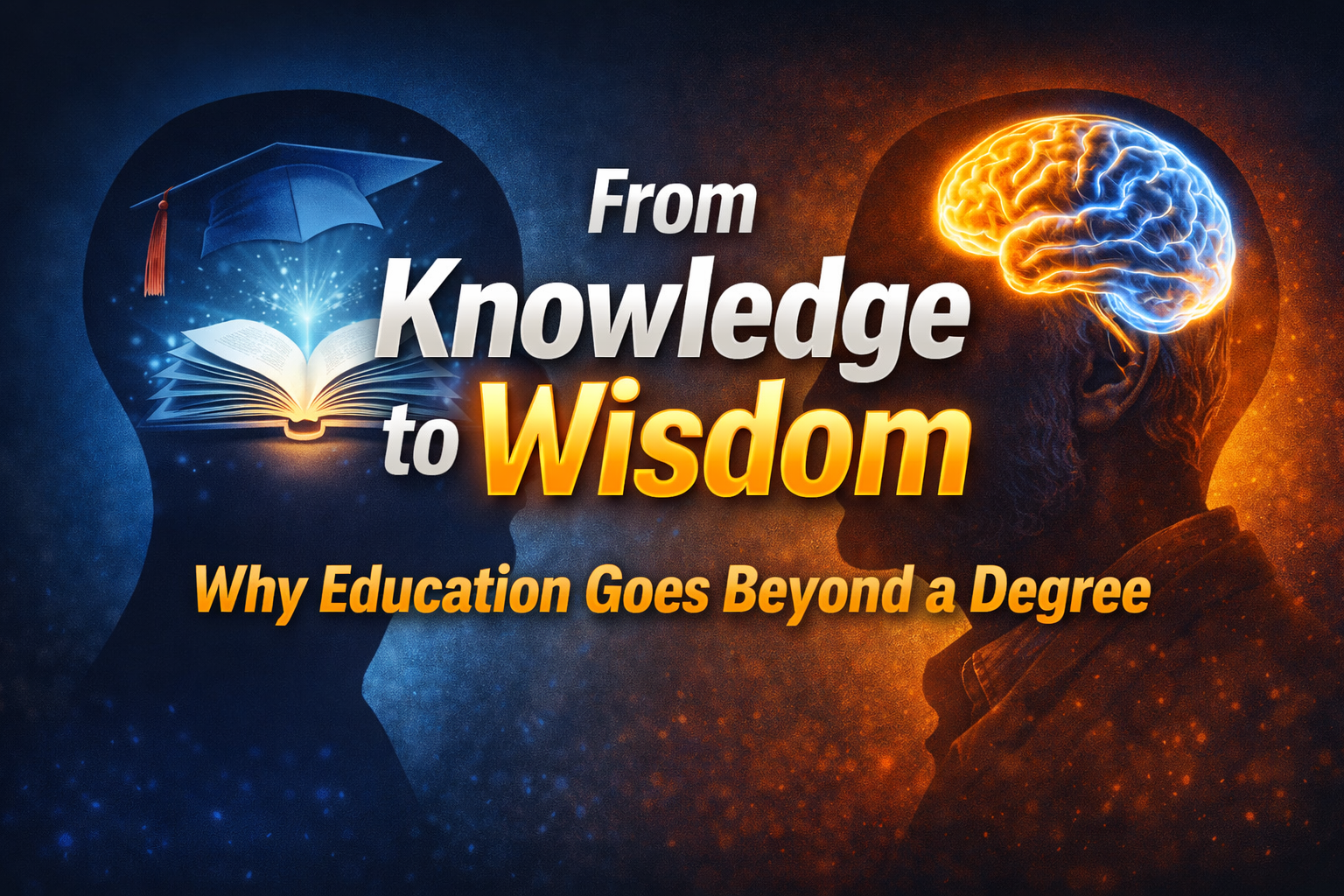
In today’s fast-changing world, education is often reduced to a certificate—a degree that promises a job and financial security. But true education goes far beyond grades, exams, and qualifications. It is not just about what you know, but how you think, act, and grow.
The real purpose of education is to transform knowledge into wisdom.
📘 Knowledge vs Wisdom: What’s the Difference?
Knowledge is the collection of facts, information, and skills gained through study or experience. Wisdom, on the other hand, is the ability to apply that knowledge thoughtfully and ethically in real-life situations.
- Knowledge tells you what is right.
- Wisdom helps you decide what is best.
A person may have multiple degrees yet struggle with decision-making, relationships, or adaptability. That’s where wisdom becomes essential.
🧠 1. Critical Thinking Over Memorization
Traditional education often emphasizes memorizing information. However, in real life, success depends on critical thinking—the ability to analyze, question, and solve problems.
Wisdom grows when you:
- Ask “why” instead of just accepting facts.
- Evaluate different perspectives
- Make informed decisions under uncertainty.
🌱 2. Learning to Adapt in a Changing World
The world in 2026 is evolving rapidly with AI, automation, and global challenges. What you learn today may become outdated tomorrow.
True education teaches you:
- How to adapt to change
- How to learn new skills continuously
- How to stay relevant in any field
Wisdom is not static—it evolves with experience.
❤️ 3. Emotional Intelligence Matters
Success is not only about intelligence; it’s also about understanding people and emotions.
Education beyond a degree helps you develop:
- Empathy and communication skills
- Self-awareness and emotional control
- Strong relationships in personal and professional life
Many highly educated individuals fail not due to lack of knowledge, but due to lack of emotional intelligence.
⚖️ 4. Ethics and Responsible Decision-Making
Knowledge gives power, but wisdom ensures that power is used responsibly.
A truly educated person:
- Makes ethical decisions
- Understands consequences
- Acts with integrity
In careers like medicine, engineering, business, or leadership, ethical judgment is just as important as technical skills.
🌍 5. Real-World Experience Shapes True Learning
Degrees provide a foundation, but experience builds wisdom.
You learn more when you:
- Face challenges and failures.
- Work with diverse people.
- Apply theory in real situations.
Education should prepare you not just for exams, but for life.
🎯 The Bigger Picture
A degree may open doors, but wisdom determines how far you go. In 2026 and beyond, the most successful individuals are not just knowledgeable—they are:
- Adaptable
- Emotionally intelligent
- Ethical
- Lifelong learners
🧠 Final Thought
Education is not a destination—it’s a lifelong journey. The goal is not just to earn a degree, but to become a thoughtful, responsible, and wise human being.
Because in the end:
👉 Knowledge makes you informed, but wisdom makes you effective.
👉 Knowledge makes you informed, but wisdom makes you effective.
❓ FAQs
1. Why is a degree not enough today?
Because the modern world requires skills like critical thinking, adaptability, and emotional intelligence—things a degree alone cannot guarantee.
2. Can wisdom be taught in schools?
Partially. Schools can guide, but wisdom mainly develops through real-life experiences and self-reflection.
3. Which is more important: knowledge or wisdom?
Both are important, but wisdom is more valuable because it determines how effectively knowledge is used.
4. How can I develop wisdom?
By learning from experiences, reflecting on decisions, staying open-minded, and continuously improving yourself.
5. Does success depend more on wisdom?
Yes. Many successful people attribute their achievements to decision-making, adaptability, and emotional intelligence—not just academic knowledge.

Be First to Comment